


When was the last time you listened to the shape of a room? Not the music in the room, but the room itself—the unique, resonant frequency of its “silence?” When did you last stop to intentionally hear the complex, accidental symphony of your environment: the polyrhythms of household appliances, the drone of distant traffic, the subtle timbre of the wind?
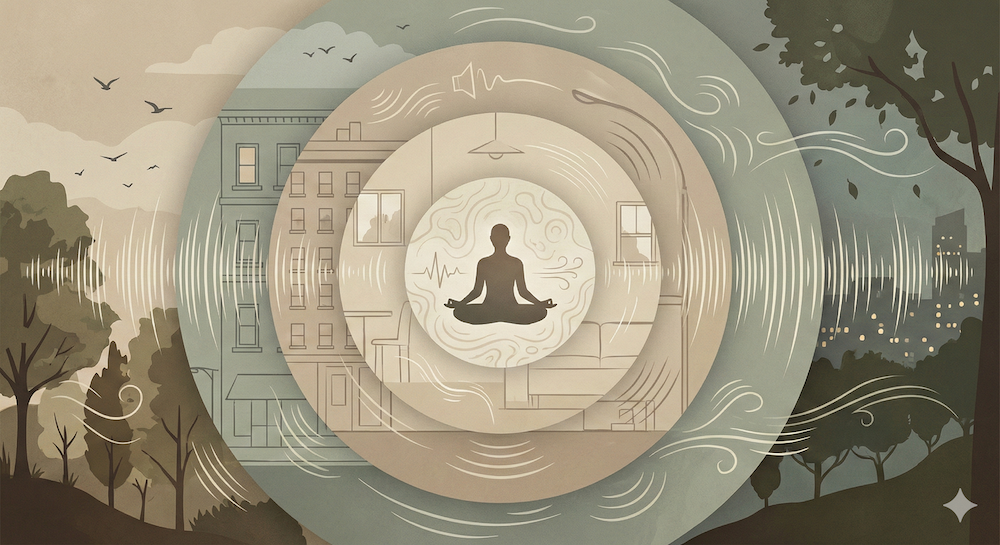
We are trained, as musicians, to focus on the sounds we make. We strive to project, to fill a space, to send our carefully practiced notes out into the world. But what if we’re missing half of the equation? What if the most profound, transformative, and vital skill of all is not in projecting, but in receiving?
In our last article, we brought our listening practice home from the vast, communal soundscape of the convention hall and into the focused intimacy of the practice room. We explored how to listen with and through the body, using somatic practices to deepen the connection between our physical selves and the sounds we produce. We ventured into the ensemble, reimagining it not as a group of individuals playing “at” the same time, but as a living, breathing “conversation among friends,” a dynamic exchange of musical intent.
The goal was to move beyond simply hearing and into a more active, embodied, and empathic mode of engagement. That article concluded with a small note mentioning that an interview with the brilliant flutist Claire Chase would be appearing in this very issue.
As fate, or perhaps resonance, would have it, that conversation with Claire—which you can read elsewhere in these pages—began at the very heart of this topic. We were discussing her monumental new work, Elwha, a collaboration with a river, when she brought up the foundational influence in her life, the one who gave her “permission” to think in such expansive terms.
That person, of course, was the visionary composer, philosopher, and humanitarian, Pauline Oliveros.
It was one of those moments of beautiful synchronicity. Here I was, deep in a series on the “lost art” of listening, and one of the world’s most innovative musicians was independently reinforcing the same central thesis: that our relationship with sound is not just a musical practice, but a life practice. For Claire, as for Pauline, “how we listen creates our life.”
This, I realized, was the perfect bridge. We’ve talked about active listening and embodied listening. Now, it’s time to go deeper, to the very source. It’s time to talk about Deep Listening®.
The Philosopher of Attention
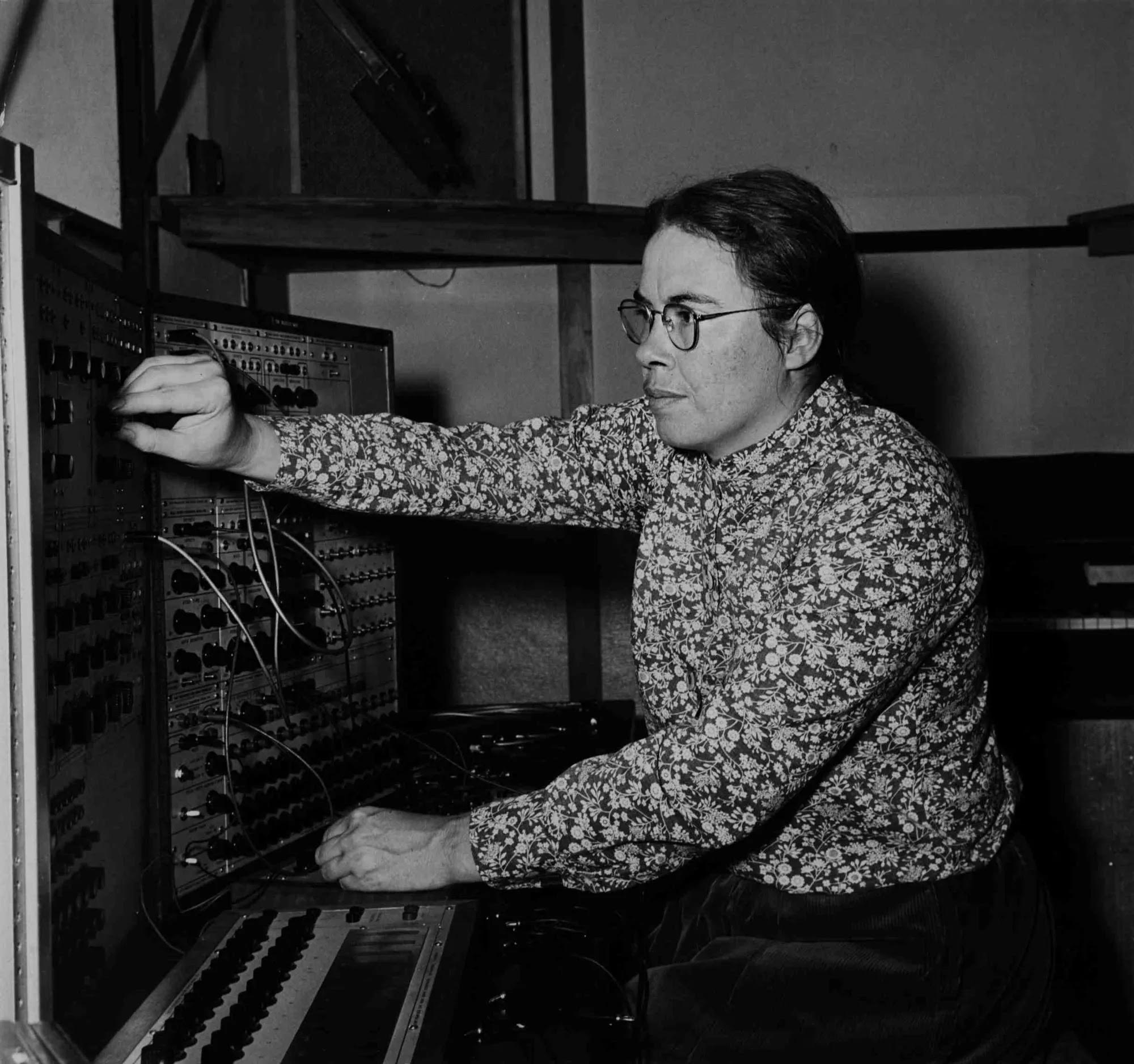
Who was Pauline Oliveros? If you haven’t encountered her work, it’s impossible to overstate her importance. She wasn’t just a composer who played the accordion and worked with early electronics; she was a philosopher of attention. She was one of those rare figures, like John Cage, who didn’t just write music but fundamentally challenged our very definitions of what music is, what silence is, and what it means to listen.
Decades ago, Oliveros pioneered this practice, which she named “Deep Listening.” But what does it mean?
We’ve already discussed active listening—the focused, analytical engagement we use in the practice room or when studying a score. Deep Listening includes this, but it expands our awareness outward and inward, simultaneously. Oliveros often spoke of the difference between “focal attention” (the “spotlight” we shine on a single sound, like the principal oboe’s A) and “global attention” (a “floodlight” that illuminates the entire sound field at once).
Deep Listening is the practice of cultivating that global, 360-degree awareness. It is a holistic approach, asking us to be radically attentive to the totality of our sonic environment.
This means listening to:
- The External: The music being played, yes, but also the hum of the HVAC system, the rustle of a program in the fifth row, the distant traffic, the resonance of the hall itself.
- The Internal: The sound of our own breathing, the rhythm of our heartbeat, the subtle sensations in our body, and even the “sound” of our own thoughts as they arise and pass.
For Oliveros, there was no such thing as an “unmusical” sound. Like Cage, she understood that silence is never empty; it is simply a space filled with sounds we have trained ourselves to ignore. Deep Listening is the practice of un-training that habit of exclusion. It is an invitation to accept all sound as part of a single, complex, and ever-changing score.
She famously created Sonic Meditations, which weren’t traditional compositions but rather text scores—simple, poetic instructions for listening. An instruction might be as simple as: “Listen to the sounds of your own body, and then gradually expand your listening to include the room, the building, and the world outside.”
This wasn’t about achieving a specific musical result. It was about changing the listener. It was, and is, a form of meditation, but with sound as its anchor.
From Philosophy to Practice: More from the Sonic Meditations
This can all sound wonderfully abstract. But like the somatic methods we explored in our last article, Deep Listening is, above all, a practice. It’s something you do, not just something you think about. The “Tuning Meditation” we will explore in a moment is perhaps her most famous, but the collection it comes from, Sonic Meditations, is a treasure trove of practical exercises for musicians.
Let’s look at the very first one, which she subtitles, “Teach Yourself to Fly.”
Sonic Meditation I: Teach Yourself to Fly
“Take a walk at night. Walk so silently that the bottoms of your feet become ears. Each sound heard awakens a different part of your body. When you feel that your body is thoroughly tuned, begin to sing any sound that comes to you. Continue singing, freely varying the sound, until you have reached your destination. Then, take a different route back to your point of origin.”
How a Flutist Can Practice This: You don’t need to do this at night, or even outside, to capture its essence. The core instruction is: “Walk so silently that the bottoms of your feet become ears.”
Try this in your home, your studio, or a hallway. Put your flute down. For five minutes, just walk. Make your only goal to be utterly silent, to make your footfalls inaudible. What do you notice? You become instantly aware of your balance, your posture, the way your weight shifts from heel to toe, the texture of the floor. You are, in essence, practicing the “poise and balanced coordination” we discussed from the Alexander Technique. You are listening with your whole body.
When you’ve “tuned” your body this way, pick up your flute. Don’t play a piece. Just “begin to sing” through the instrument. “Sing any sound that comes to you. Continue singing, freely varying the sound…” This is not about executing music; it’s about releasing it from a place of heightened physical awareness.
What This Teaches: This meditation is a direct path to the “embodied awareness” we’re seeking. It short-circuits the critical brain (“Was that in tune? Was that rhythm correct?”) and connects sound-making directly to physical sensation. It’s a profound cure for a ‘cerebral’ practice session where you feel stuck in your head, disconnected from the music. Think of it this way: the physical control needed to release the unnecessary tension that makes a footfall loud is the exact same awareness you need to release the unnecessary tension in your jaw, shoulders, or fingers when facing a technically demanding passage in any piece you’re working on.
Two More Exercises in Deep Listening
The text scores open up a new way of thinking. Now, let’s look at two more ways to apply these principles, one solitary and one communal.
The Practice Room: Listening to the Silence
In our last article, we modified a long-note exercise to listen inwardly to the body’s sensations. Let’s take that a step further with an Oliveros-inspired approach.
The Exercise: The Room as a Drone
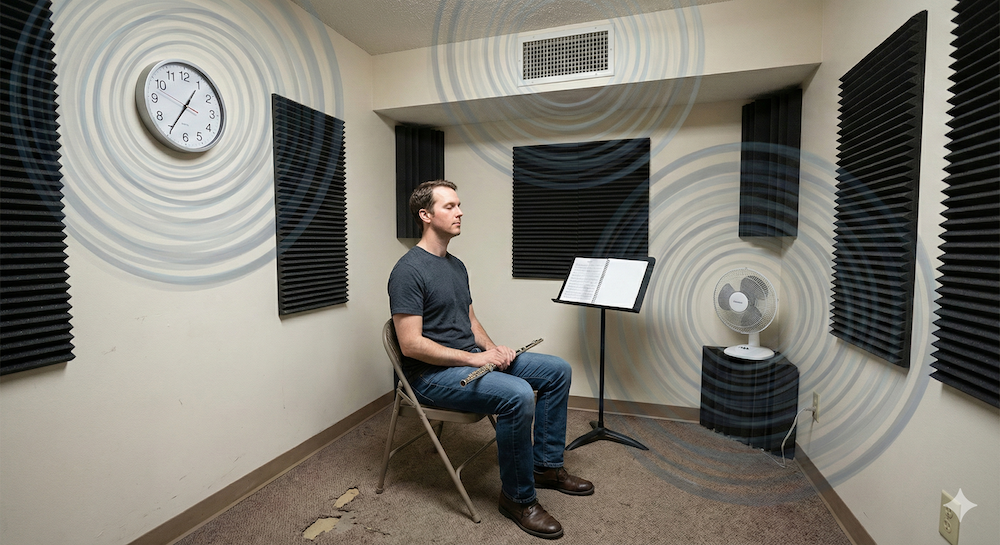
- Arrive and Settle: Go into your practice room. But before you even open your flute case, set a timer for five minutes. Sit comfortably. Close your eyes.
- Listen Outward (Global): For the first two minutes, consciously open your ears. Your only job is to notice, without judgment, every sound that enters your awareness. Don’t label them as “good” or “bad,” “musical” or “noise.” Just receive them. Hear the computer fan. The ticking clock. The pipes in the wall. The neighbor’s dog. The sound of the air moving through the vents. This collection of sounds is the true drone of the room. It is the fundamental “key” of your environment.
- Listen Inward (Internal): For the next two minutes, gently shift your focus. Keep your “global” ears open to the room, but now, bring your “focal” attention to the sounds within you. Your breath—the texture of the inhale, the release of the exhale. The beat of your heart, if you can sense it. The sound of your swallowing.
- Play (The Integration): When the timer goes off, open your eyes. Assemble your flute. Now, play one single long note.
- The Question: As you play, your new task is not to judge the note’s quality. Your task is to listen to how your note changes the room. How does your sound interact with the drone of the HVAC? How does it vibrate in the existing soundscape? You are not imposing a sound onto a silent space; you are adding your voice to a rich, complex, and ongoing conversation.
The Goal: This exercise radically reframes the act of practicing. It shifts you from a mindset of “criticism” (“Was that note good?”) to one of “awareness” (“What was that note?”). It builds a profound connection to your environment and turns the simple long tone into an act of collaborative sound-making with the world itself.
The Ensemble: The Tuning Meditation
In our last article, we discussed Goethe’s idea of chamber music as a “conversation among friends” and tried a call-and-response exercise. Oliveros created a piece that is perhaps the ultimate expression of this idea, a “conversation” for an entire community. It’s called the “Tuning Meditation.”
It’s beautiful in its simplicity and profound in its effect. You can do this with your flute choir, your woodwind quintet, or a room full of 100 people.
The Exercise: The Tuning Meditation
- The Setup: Have everyone sit in a circle. The instruction is simple: “Begin by taking a deep breath and listening to the sound of your own breathing. Gradually, become aware of the breathing of everyone else in the room.
- The Starting Note: “When you are ready, sing (or play) a single, comfortable pitch. Just one long, sustained tone.”
- The Core Instruction: “Listen to all the pitches in the room. Really listen. Try to hear every single sound. At some point, you may find that you can no longer hear your own voice (or flute). Your note has been absorbed into the collective ‘drone.’
- The Change: “When that happens—when you can truly no longer distinguish your own note from the whole—gently and slowly, change your pitch to match a new pitch you hear in the room. It must be a note you are actually hearing someone else sing or play. Match it precisely.”
- The Process: Let this continue for 10, 15, or even 20 minutes.
The Result: What happens is extraordinary. The group, without a conductor or a score, begins to create a slow-moving, shimmering, and utterly unique chordal progression. It’s an organism of sound. Individuals make choices, but those choices are only made in direct, empathic response to the group.
The Goal: You are not leading. You are not following. You are participating. This is the “conversation” taken to its most elemental level. It is, in practice, the very “Unity and Universal Oneness” we discussed in the first article of this series. Imagine starting every rehearsal this way, not with a single ‘A’ from a tuner, but with a collective act of finding your own ‘A’—your own attunement.
You can see and hear a beautiful, large-scale performance of the “Tuning Meditation” recorded in 2017 at The Met Cloisters, where over 100 people gathered to sing in the Fuentidueña Chapel.
The Brain That Listens: Focus, Flow, and Freedom
Why do this? Why dedicate precious practice time to listening to air conditioners or walking silently? Because this practice is not an escape from our work; it’s a tool to go deeper into it. It’s a form of mental and neurological training for the high-stakes act of performance.
As musicians, we live in terror of the “critical mind”—that nagging inner voice that shouts “That was flat!” or “You’re rushing!” in the middle of a performance. This practice is how we learn to quiet it. Deep Listening is, in essence, a mindfulness practice for the ears. It trains the brain to shift from that narrow, judgmental “focal” attention to a wide, receptive “global” attention.
This is the very definition of a “flow state.” You can’t be in a state of flow and simultaneously be judging yourself. They are mutually exclusive modes of attention. By practicing the non-judgmental reception of all sound, we are literally building the mental pathways that allow us to be fully present in our music-making. We are training our brains to stay in that global, receptive state, even under pressure.
This leads to an intriguing thought. We look at artists like Claire Chase, who are operating at such an astonishing level of mastery, and we assume it’s all about output—that they just practiced their scales (and extended techniques) more, learned more pieces, and expelled more musical energy than the rest of us. But maybe we have it backward. Perhaps a great deal of their mastery comes from their intake. Perhaps they’re not just focused on the sound they are putting out, but are in a constant, active state of listening—to the room, to their colleagues, to their own bodies, to the river.
Perhaps they practice receptivity as much as, if not more than, they practice production. It’s a humbling idea: what if the secret to being a virtuoso performer is to first become a virtuoso listener?
The Ultimate Conversation: Deep Listening and Improvisation
This training in receptivity finds its ultimate expression in the art of improvisation, a topic we touched on in our last article. For many, improvisation is a terrifying black box, a “talent” you’re either born with or not. But viewed through the lens of Deep Listening, it becomes something far more practical and attainable.
Improvisation is not, at its core, about “making notes up.” It is not a monologue. It is the most intense, high-stakes, real-time act of Deep Listening you can engage in.
When you are truly improvising with other musicians, you are not just executing your “best licks.” You are processing a massive, simultaneous stream of information. You are listening to the harmonic shift the pianist just introduced, the polyrhythmic fragment the drummer is weaving, the “question” the saxophonist just played, and the energy of the audience in the room.
To do this, you must be in that state of global, 360-degree attention. You are not “thinking” in the linear, critical sense. You are perceiving and responding in one fluid motion. Deep Listening, with its “Tuning Meditations” and “Sonic Meditations,” is the practice for this skill. It’s the “long tones” for improvisation. It teaches you how to be a “co-creator” with the sound-moment, to trust your response, and to offer something that is truly part of the conversation, not just another voice shouting on top of it.
The Legacy as a Living Practice
Pauline Oliveros passed away in 2016, but her work is more vibrant and necessary than ever. As Claire Chase told me, “There’s a reason that so many people turned to the work of Pauline in the pandemic… and there’s a reason a lot of people are turning to her work in this geopolitical moment too.”
This is not a historical artifact. It is a living, breathing practice. Her work continues today through the workshops and resources offered by the Center for Deep Listening at Rensselaer, which carries on her legacy. But that legacy is not just institutional; it flows through the countless artists she inspired, a constellation of devotees who weave her philosophy into their own work—artists like Laurie Anderson, Suzanne Ciani, William Basinski, Lawrence English, and, of course, Claire Chase.
And you can see its DNA everywhere in the work of Claire Chase. She spoke of how Pauline was one of her “earliest and closest mentors,” the very first person to take her idea for a new kind of ensemble seriously. Claire’s life work, in turn, is a massive expansion of this “deep responsibility to offer that kind of mentorship to the next generation of players.”
And her monumental new work, Elwha, which we discuss in our interview, is perhaps the ultimate Deep Listening piece. It is a “three-way collaboration” with composer Annea Lockwood (a good friend of Oliveros’s) and the Elwha River itself.
Think about that. They are not writing music about the river. They are listening to the river, using hydrophones to record the “astonishing—rhythmic, pitch, motivic, melodic, harmonic material” that the river already contains. Claire and Annea have spent time “just listening to and transcribing the harmonic content, the rhythmic content” of the water.
This is the very definition of Deep Listening. It is the act of treating the world not as “subject material” or as mere “background noise” (the “sonic wallpaper” we talked about in Article 1), but as a “co-creator,” a living entity with its own voice, its own music.
When I remarked to Claire that this whole project felt “so Pauline,” she laughed and said, “Yeah. Yeah. She’s pulling the puppet strings.”
The Score Is All Around You
Why does this matter? Why, in a world of endless deadlines, practice routines, and professional pressures, should we dedicate time to… listening to the air conditioner?
Because, as our world gets louder, faster, and more fractured, our attention becomes the most valuable resource we have. Technology, as we discussed in our first article, cocoons us in “personal sonic bubbles,” allowing us to curate our lives with music, but also sealing us off from each other and the “unpredictable, and sometimes beautiful symphony of everyday life.”
Deep Listening is the antidote. It is the radical act of connection.
It is not an escape from the world; it is a profound engagement with it. It is a practice of empathy, of “community cultivation.” It is, as Claire Chase so perfectly framed it, a “life practice.”
When we practice Deep Listening, we become better musicians. We hear intonation not as a digital tuner’s decree, but as a living, shimmering relationship of vibrations. We feel rhythm not as a metronome’s rigid click, but as a shared pulse with our colleagues. We understand our role in an ensemble not as a single line on a page, but as one voice in a complex, resonant ecosystem.
But more than that, we become better listeners. And in doing so, we become better colleagues, better teachers, better partners, and better human beings.
I started this series by asking us to remember those formative moments when listening to music shifted our world. I remember my own—not just in a concert hall, but the first time I consciously tried one of Pauline’s exercises. I sat in my living room late one night, and for the first time, I heard it: the low, steady hum of the refrigerator from the kitchen; the oscillating whir of a ceiling fan; the scratchy, percussive rhythm of a branch brushing against the windowpane; the quiet tick of the house’s frame settling in the cool air.
It wasn’t noise. It was a symphony. It was music.
The art of listening isn’t truly lost. It’s just waiting to be reclaimed. The world is a score, infinite and complex, playing itself in every single moment. The invitation is always open. All we have to do is stop, be still, and read what’s written in the air.
Further Exploration
For those interested in exploring the foundational text scores discussed in this article:
- Sonic Meditations by Pauline Oliveros (ISBN: 978-1088038531): This collection contains the “Tuning Meditation” and “Teach Yourself to Fly,” along with 23 other text-based instructions for practice. You can find it here.
- A Year of Deep Listening: 365 Text Scores for Pauline Oliveros (Edited by Stephanie Loveless, ISBN: 978-1949597340): If you are worried about finding time to practice, this book offers a “bite-sized” approach. It features a short, simple listening prompt for every day of the year, making it a perfect companion for building a daily listening habit.